A journey planner can connect dots without connecting services. MaaS works when reliable data, valid tickets and clear responsibilities support the whole trip.
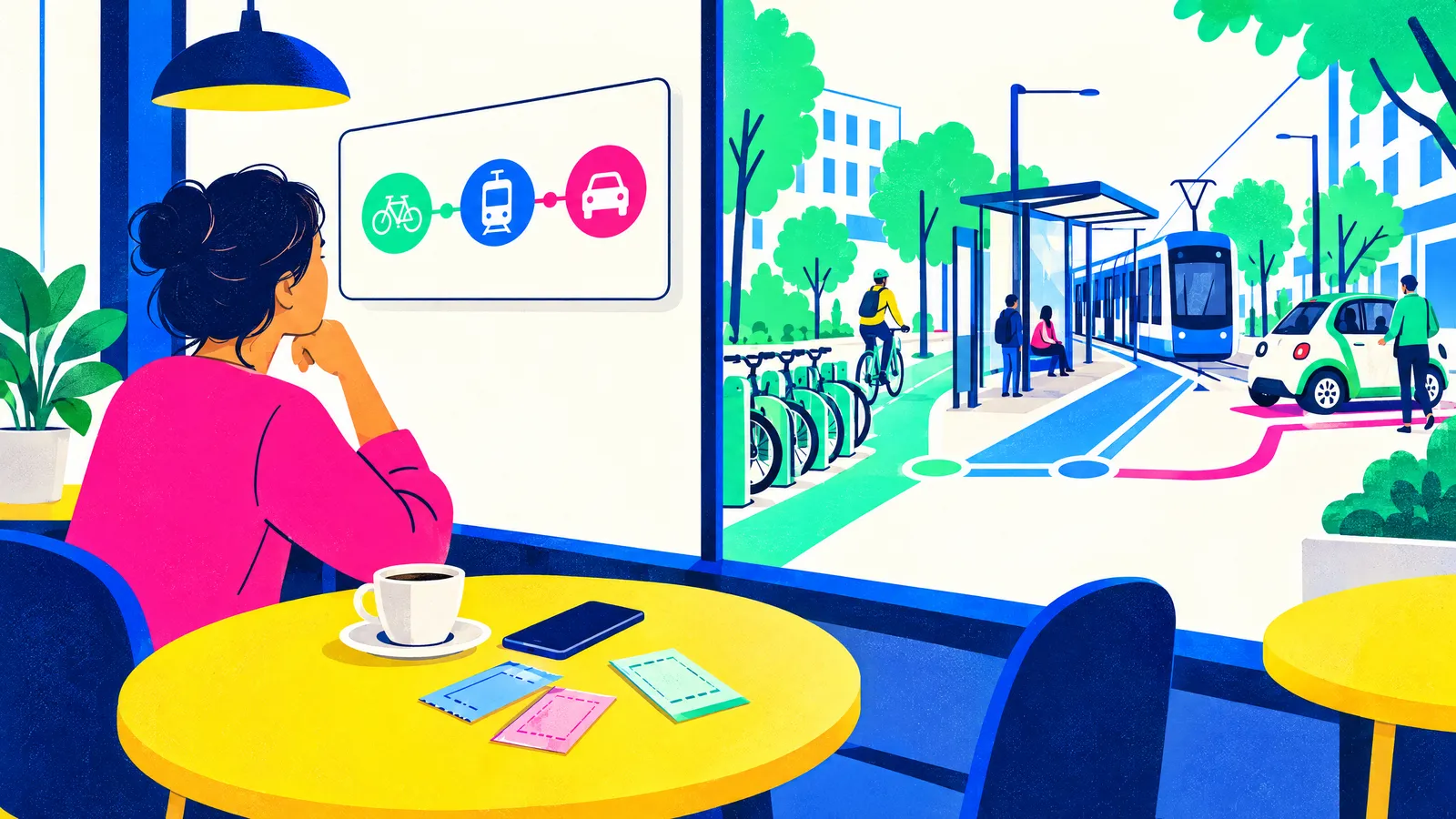
Say you're leaving a café in Berlin with a bag of groceries. Your phone suggests a tram and a shared bike. The connection looks good, but the tram ticket opens another app, the bike requires a separate account, and neither service explains what happens if the tram is late. Mobility as a service, or MaaS, promises to reduce that work by bringing transport options into one service. The difficult part is making the journey hold together after you've chosen it.
A good-looking route isn't enough. You need trustworthy departure information, a ticket that the operator accepts, and a way to recover when something breaks. Those requirements deserve attention before another screen gets drawn.
This is familiar territory for move lab, the Berlin urban-mobility lab building prototypes, open-source tools and data visualisations. Its moovel Go experiments explored access to nearby transport without starting inside an app. The gtfs edtr prototype addressed missing public transport data, while hī di considered connections between formal and informal services. Together, these projects offer useful ways to separate the interface from the work needed behind it.
What does mobility as a service integrate?
Two products can both claim to be MaaS while offering very different journeys. One compares departure times. Another sells tickets. A third promises a monthly package with a single customer relationship. If your procurement brief calls all of them “integrated”, you can't tell which obligations you're buying.
Sochor, Arby, Karlsson and Sarasini (2018) proposed five integration levels, numbered 0–4. Their taxonomy gives you a more precise vocabulary:
- Level 0: no integration. Services remain separate. In a typical case, a passenger checks a bus timetable, then opens a bike service independently. Each operator can provide a useful service, but the passenger does the connecting work.
- Level 1: integration of information. A common interface brings travel information together, such as routes, times and prices. Your passenger can compare options without consulting every operator. That doesn't mean the interface can sell what it recommends.
- Level 2: integration of booking and payment. The passenger can arrange and pay for travel through the service. The challenge moves from displaying an option to completing a transaction that another organisation recognises. Reservations, ticket validity and payment failures become product responsibilities.
- Level 3: integration of the service offer. The service combines offers through arrangements that include contracts and responsibilities, potentially using bundles or subscriptions. A common checkout alone doesn't establish this level. The wider offer and customer relationship need integration too.
- Level 4: integration of societal goals. Public objectives become part of how the service is organised. For your city, that could mean supporting access to jobs or reducing car dependence through agreed policy and operating arrangements, rather than adding a green badge to a route.
The numbers describe types of integration. They aren't a measured quality score. A dependable level 1 planner may serve a passenger better than a level 3 package that excludes their usual bus.
Your brief becomes more useful when it states both the intended level and the journeys covered. “Booking and payment for bus and bike trips within the pilot area” is testable. “All your mobility in one place” leaves too much room for disagreement.
A valid ticket needs more than a common checkout
Say a passenger pays for a train-plus-bike journey in one transaction. The train arrives late, the bike reservation expires, and the passenger asks for help. A shared payment screen hasn't decided who can extend the reservation, issue a refund or fund the alternative.
That decision belongs in the service agreement. The UK Department for Transport's MaaS code of practice (2023) asks providers to “set out points of contact for users upfront” and clarify responsibility for compensation and refunds. It's voluntary UK guidance, but the product question travels well: who owns the passenger's problem?
An API, or application programming interface, lets systems exchange requests and responses. A ticketing API can support a sale; it doesn't, by itself, give your platform permission to resell tickets. Commercial terms still need to cover access, prices and settlement, meaning the transfer of money between the parties. The operator's validation system must recognise what you've issued.
A practical acceptance test follows one ticket from price quote to inspection, then through cancellation and refund. It includes a failed payment and an unavailable service. That's more revealing than testing successful checkout alone.
And common payment isn't always the best next investment. Where passengers already tap a card to board, an extra purchasing flow may add work. You could retain that familiar payment method and improve connection information first. The trade-off is less control over the full purchase journey, but potentially less effort for the passenger.
GTFS needs an owner and an update routine
A route can look plausible while directing someone to the wrong side of a station. Say a bus stop moves during roadworks, but the feed still points to its old location. Your planner may calculate a perfect transfer to a stop that no longer exists.
The General Transit Feed Specification documentation distinguishes GTFS Schedule from GTFS Realtime. Schedule describes services through structured data about stops, routes, trips and service dates, with optional information such as fares and transfers. Realtime carries updates including delays, cancellations, service alerts and vehicle positions. A scheduled departure isn't a live prediction.
Neither feed is a complete retail system. Fare data can help explain a price, but ticket issuance and settlement need separate arrangements. That distinction prevents a common planning error: budgeting for a data connection as though it also delivers booking rights.
The lab's gtfs edtr public transport data concept tackled the earlier problem of generating and improving the information itself. Interaction Design students Jan Asmus and Raphael Dirr developed the mobile app prototype at HfG Schwäbisch Gmünd in cooperation with moovel lab during the summer semester of 2016. The concept let users contribute transport data and explored recording complete routes.
Crowdsourcing gives you a way to discover gaps that a central database misses. But contributions need review. A recorded ride can suggest a route; it doesn't establish that the service follows that route every day.
Your operating plan could assign a named owner to each feed, a review process for corrections, and a response time for serious faults. Automated checks can flag invalid references or expired service dates. Field checks can establish whether an entrance is usable and a transfer is realistic. These checks answer different questions.
A useful interface also distinguishes current updates from scheduled information when live data disappears. It's better to show an honest timetable than a prediction that hasn't been refreshed.
Why did so many MaaS apps struggle?
A passenger already has ways to find a bus and pay for it. A new app asks them to learn another interface, perhaps create an account, and trust another organisation. If the new service doesn't solve a recurring problem, its extra features won't necessarily earn repeat use.
The International Transport Forum's MaaS report (2021) treats MaaS as a distribution model for mobility and describes uncertainty around viable business models in low-margin transport markets. It also warns that MaaS needs high-quality public transport. Software can't make an hourly bus arrive every few minutes.
Later pilot evidence makes the operational barriers concrete. Transport Scotland's investment fund evaluation (2025) found booking and payment integration difficult across all five pilot projects. Some operators lacked technical capacity; others already had established systems and little reason to adapt them for a trial. API connections needed continuing updates on both sides.
The evaluation also found that commissions weren't sufficient to cover costs in pilots using that model; others operated on a not-for-profit basis. Some participants valued journey planning more than in-app ticketing, particularly where existing cards and contactless payments already worked. These findings explain failure mechanisms, rather than proving that every MaaS model is unviable.
Ticket volume isn't the same as platform revenue
A busy checkout can disguise a weak business case because most ticket revenue belongs to the transport operator. Say your illustrative service sells 40 tickets per user each month at €3, retaining a 5% commission. The calculation is 40 × €3 × 0.05 = €6 per user per month. If account operation and customer support cost an assumed €8, the service loses €2 before wider product development costs.
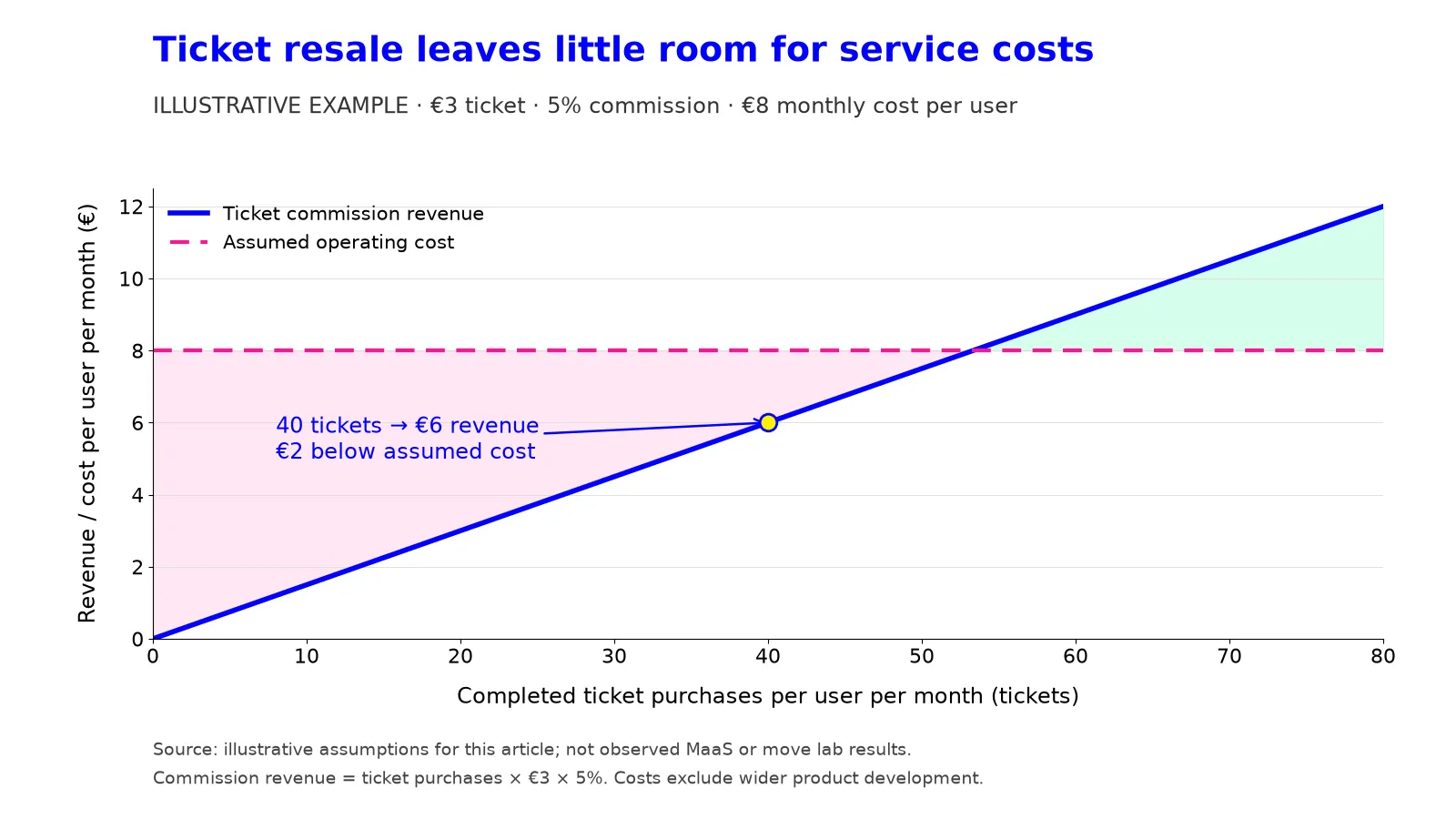
At 40 monthly purchases, the example earns €6 in commission against €8 in assumed costs. These are illustrative assumptions, not observed pilot results. Source: move lab editorial calculation.
A subscription doesn't automatically fix that gap. Your price has to cover the journeys people actually take, including expensive modes and support. An employer or public authority might instead pay for a defined access service. That changes who buys the service and what you need to demonstrate; it doesn't remove the cost.
So your business case needs a payer, an operating budget and an explanation of the added value. If public funding buys better access for people who struggle to travel, that objective deserves its own assessment. It shouldn't be disguised as ticket-resale profit.
The useful interface starts at the moment of choice
A departure countdown can tell you a bus leaves soon without telling you whether you can catch it. In a typical café case, the bus leaves in six minutes and the stop is seven minutes away. The number is accurate. The advice isn't useful.
The moovel Go v1 mobility printer made nearby car2go availability visible and allowed reservation through a member card, followed by a printed vehicle location. Its printer proved slow and required maintenance, prompting a different direction for v2. This was a prototype lesson, rather than evidence of a scaled transport service.
In the 2015 multimodal moovel Go update, the lab explored bringing nearby mobility points onto the display. Moving from one number to several transport options raised a specific question: how would someone know when to leave the café for public transport? The team also explored information about the departure point.
That question is still useful for your product. A “leave by” time links walking time to departure time. It can help someone choose before they pick up a phone. A lobby display or shared screen may reach people who haven't installed your app, although personal booking still requires an appropriate account and interaction.
The lesson isn't that MaaS needs wall-mounted hardware. It's that the first useful interaction may happen outside your app. Your interface can support the decision where it occurs, with enough information to act and no suggestion that an unreserved vehicle is guaranteed.
Informal transport belongs in the service definition
A citywide planner can omit the services that people use daily because those operators don't supply a convenient data feed. In a typical mixed network, a minibus connects a neighbourhood to rail, yet the planner presents a long walk instead. Digital coverage then defines the journey more than actual transport does.
The lab's hī di mobility service concept for Addis Ababa considered formal and informal modes together. It envisioned planning, booking and paying across existing services, including minibuses and rail. The concept also identified political backing and government support for minibus owners and drivers as part of integration. It was a proposal, not a deployed MaaS system.

Mapping a mixed network starts with the people operating and using it. This conceptual Addis Ababa-inspired scene illustrates the article's argument, rather than documenting a hī di deployment. Source: AI-generated editorial illustration for move lab.
Your integration work could begin with route mapping and passenger information before promising digital payment. Operators need a reason to participate, a manageable update process and clarity about how their data will be used. An arrangement that creates reporting work without improving their service may be hard to sustain.
Uncertainty also needs a truthful representation. Where departure times aren't fixed, a timetable with invented precision creates false confidence. Information about typical frequency or operating conditions can be more useful, provided the data supports it. Cash payment and assisted access may remain necessary alongside digital options.
The trade-off is a less uniform interface. That's acceptable if uniformity would hide how the service actually works.
A pilot needs evidence about completed journeys
Downloads can rise while passengers continue using the same routes and payment methods. A route search also doesn't prove that a trip happened. If your goal is reduced car use, neither measure tells you whether you've achieved it.
A useful pilot starts with a narrow passenger problem, say reaching an early hospital appointment from a district with poor connections. Your evaluation can follow the outcome: was a suitable journey available, could the passenger book what needed booking, and did they arrive? Support incidents can reveal which handoffs fail.
Service quality measures might include ticket rejection and recovery time after a disruption. Policy measures need different evidence, such as how people previously made the same journey. A comparison group, where practical, helps separate the platform's effect from changes in fares or transport supply.
Your data-sharing agreement also deserves a clear purpose. Operators need service information to coordinate trips; city planners may need aggregated demand patterns. They don't necessarily need identifiable travel histories. Pseudonymised records aren't automatically anonymous, and unnecessary collection adds privacy risk without answering a better question.
A useful MaaS service owns the handoffs
The café passenger's problem returns whenever responsibility stops at an operator boundary. One service sells a ticket; another controls the bike reservation. The passenger still has to connect them when the plan changes.
Mobility as a service earns its place when those handoffs become dependable. Your first release might offer accurate information rather than a subscription. Your next investment might fund a feed maintainer or an operator agreement rather than another feature. A sensible test is whether the passenger can complete the promised journey and get help when they can't. Integration has value when that answer improves.
Frequently asked questions
What are the five MaaS integration levels?
Sochor et al. (2018) distinguish level 0, no integration; level 1, information; level 2, booking and payment; level 3, the service offer, including contracts and responsibilities; and level 4, societal goals. The categories help you describe what a service integrates; they don't prove that users prefer it or that it reduces car travel.
Does GTFS let you buy public transport tickets?
GTFS describes transport services and can include fare information. It doesn't itself issue a valid ticket or settle money between operators; those functions need ticketing interfaces and commercial agreements. GTFS Realtime adds current service information, rather than a sales system.
Does a MaaS service need a subscription?
No. Booking and payment can work on a pay-as-you-go basis, while subscriptions or bundles are ways to integrate the wider service offer. A bundle makes sense when its price and coverage fit real travel habits, rather than requiring people to buy modes they rarely use.