A short workshop needs a clear learning goal. These four exercises help mobility teams choose a useful activity, plan the session and leave with a question worth testing.

A route planner can offer a quick connection while leaving you unsure which side of the road has the stop. A ticket screen can look clear until you're holding a shopping bag in the rain. Design thinking exercises help mobility teams examine those ordinary moments before committing to a solution. The useful ones produce a changed assumption or a testable question. A wall covered in sticky notes isn't enough.
That link between an everyday experience and a tangible experiment fits move lab, a Berlin urban-mobility lab building prototypes, open-source tools and data visualisations. OpenDataCam's object-counting and tracking tool makes movement measurable; What the Street!? makes the space occupied by mobility visible. A workshop needs a similar discipline: something specific that people can inspect and discuss.
Which design thinking exercises fit your team's problem?
Teams often choose an activity because it's familiar. Say a city team has 25 minutes to discuss a confusing interchange, but spends most of them generating names for a new app. The exercise runs smoothly. The uncertainty remains.
Your starting question gives you a better selection rule:
- The team hasn't experienced the process: a 60-minute phone redesign gives pairs a complete learning cycle.
- The problem is still vague: a 20-minute journey reconstruction separates what happened from what colleagues assume.
- The team has settled on its first answer: a 15-minute silent sketch round produces alternatives before discussion.
- A concept depends on people and physical cues: a 25-minute service role-play exposes gaps between steps.
These are suggested working times for the formats below, not measured results or official move lab schedules. They include each exercise's opening and reflection, but not participant recruitment or room preparation. Group sizes exclude the facilitator. Longer sessions may be needed for interpretation, assistive technology or breaks.
Stanford d.school's Design Thinking Bootleg (2018) identifies five modes: empathise, define, ideate, prototype and test. They're modes you can return to, rather than a compulsory sequence for every meeting. A sketch round covers part of that process; it doesn't become a full cycle because it uses a timer.
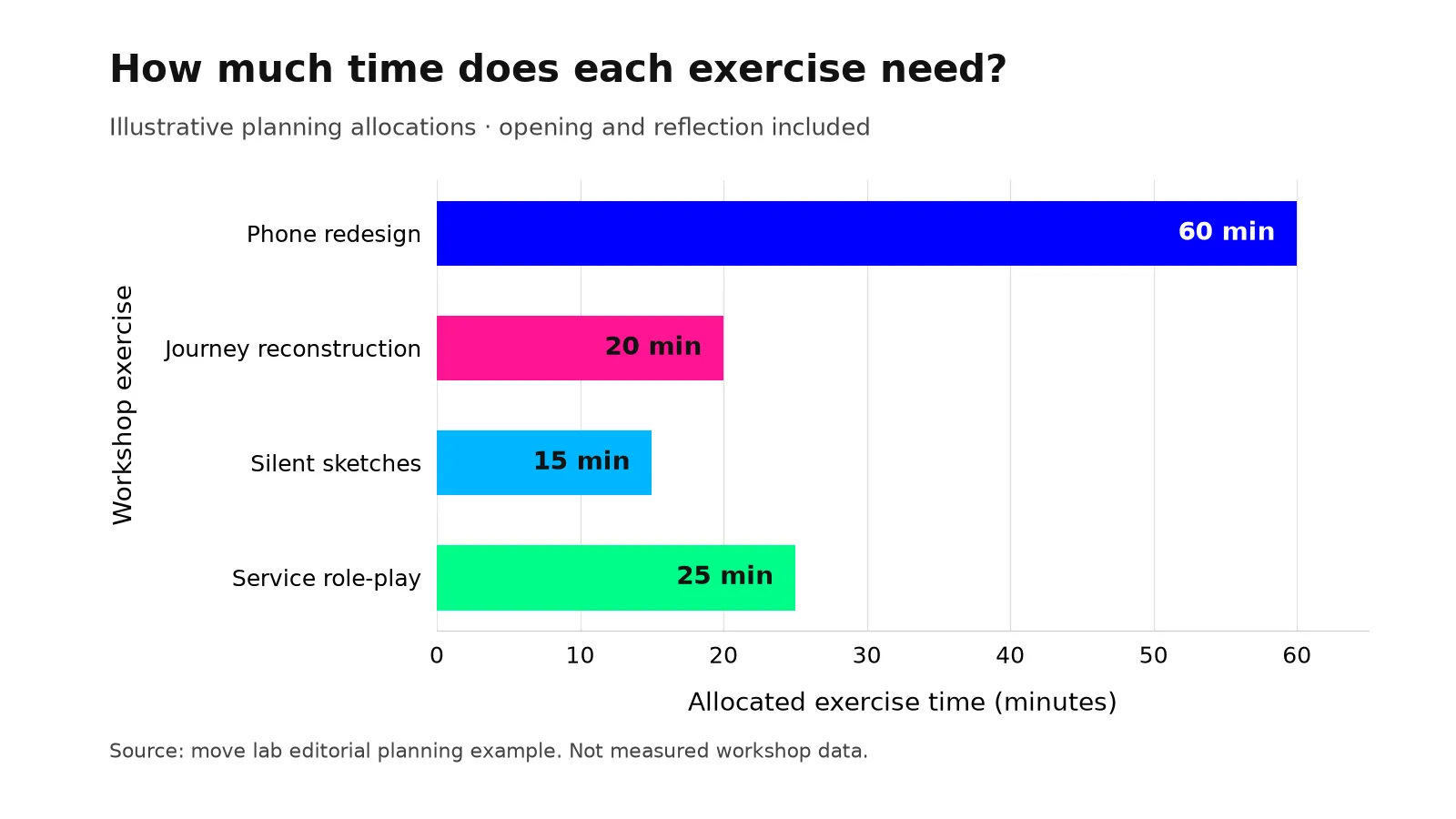
The longest format teaches the whole cycle; the shorter formats address a specific workshop question. Source: move lab editorial planning example, not measured workshop data.
A phone redesign teaches the full cycle in 60 minutes
A first-time group often jumps from hearing a complaint to proposing a feature. Say a colleague describes repeatedly checking a departure board. Someone immediately suggests more notifications. You haven't yet learned whether the worry is a late bus, a missed connection or uncertainty about where to wait.
The lab's Walk Me Through Your Phone exercise, published in 2020 by Markus Kreutzer and Benedikt Groß, is an iteration of Stanford d.school's Wallet Project. It uses a participant's phone to experience a full design thinking cycle in a short time frame. The post also mentions an oral-hygiene project and redesigning the gift-giving experience as variants.
The Stanford Wallet and Gift-Giving activities use reciprocal interviews and designing for a partner. Familiar possessions provide a starting point for stories about habits and needs. OECD's Observatory of Public Sector Innovation lists the Gift-Giving Experience Project (2012) as a 90-minute activity plus debrief. The 60-minute plan here is a shorter adaptation, not the lab's documented timetable.
Group and materials: 2–12 people in pairs; participant-controlled phones, paper, thick pens, sticky notes, scissors and tape. One facilitator keeps the stages moving. A paper account of a recent trip is an alternative for anyone who doesn't want to use a phone.
Prompt: “How could your partner feel more certain about the next step of a trip?” This leaves room for an improved sign or service interaction, rather than assuming another screen is the answer.
The proposed hour works like this:
- 4 minutes — scope and privacy. Partners agree on a recent trip and what they're comfortable showing. Nobody needs to open messages, payment details or location history.
- 12 minutes — reciprocal interviews. Each partner has six minutes to describe the trip, using the phone only as a prop. Questions such as “What happened next?” and “What made you check again?” reveal the sequence without suggesting features.
- 6 minutes — problem framing. Each person writes a need supported by the story, then checks the interpretation with their partner. “Needs reassurance that this is the correct stop” is more useful than “needs a better app”.
- 10 minutes — ideas and early feedback. Each person sketches alternatives for four minutes. Partners then take three minutes each to discuss which approach addresses the need and why.
- 14 minutes — building. Both people make rough prototypes at the same time. A paper sign, a few linked screens or a short service script can be enough.
- 10 minutes — reciprocal tests. Each partner gets five minutes to attempt a task with the other's prototype. The maker watches before explaining.
- 4 minutes — reflection. Each pair records an assumption that changed and a question the prototype couldn't answer.
That allocation totals 4 + 12 + 6 + 10 + 14 + 10 + 4 = 60 minutes.
You get practice in listening and revising, with something concrete at the end. But a colleague's trip isn't a representative sample. The exercise teaches the method; it doesn't establish how passengers across a city behave.
A 20-minute journey reconstruction finds the right problem
Teams can agree that a transfer is “bad” while describing different failures. A planner may mean a long walk. A designer may mean poor signage. Say a passenger in Hamburg misses a connection after following a station exit sign: the map and the lived sequence tell different stories.
A journey reconstruction places those accounts in order. It works best with a recent participant experience or anonymised research notes. If you have neither, a fictional scenario can help rehearse the method, provided every inference remains labelled as an assumption.
Group and materials: 3–5 people per group; a large sheet, pens, sticky notes and one account of a specific trip. An optional station plan helps locate events, but doesn't replace the passenger's account.
Timing: three minutes establish the trip's start and end. Five minutes reconstruct the actions. Another five add information the traveller used and obstacles they encountered. Four minutes identify one decision point worth investigating; the last three record unanswered questions.
A useful sheet has separate rows for actions, information available and evidence. An emotion belongs on it when the traveller reported it, not because somebody drew a sad face beside a staircase. Unknowns stay visible. That's where your next interview can help.
The research behind Sproute's alternative-route experiment included small experiences such as drawing a map from memory. The lab described how an external object or shared experience made abstract thoughts and observations easier to discuss. A reconstructed journey serves that same practical purpose: everyone can point to the disputed moment.
The output is one focused research question. For the illustrative Hamburg case, it might be: “What information helps unfamiliar passengers recognise the transfer exit before they leave the platform?” That question is narrow enough to test. “How can we improve the station?” isn't.
Your team shouldn't vote away disagreement about what happened. Two incompatible accounts may indicate different routes, times or traveller needs. They deserve investigation before they become a consensus sticky note.
Silent sketches produce alternatives in 15 minutes
Discussion can collapse around the first credible proposal. Say an interchange team agrees to add a screen before considering whether a painted marker would answer the same question. Once a senior colleague starts describing the screen, cheaper alternatives can disappear from the conversation.
A silent sketch round gives everyone time to think before the group reacts. The aim is visibly different approaches, rather than polished drawings. Writing or describing a concept is a valid alternative for anyone who can't comfortably sketch.
Group and materials: 4–8 people; one agreed need statement, plain paper and pens. A timer is enough. A slide deck tends to consume the time you've saved.
Timing: two minutes revisit the need and its supporting evidence. Five minutes are for individual work, four for a quiet review, and four for choosing an approach to prototype. During the review, notes address the idea without guessing who drew it.
A useful constraint is that each person's alternatives change how the problem is addressed. For a traveller trying to identify a boarding point, an alternative could change the information, another the place where it appears, and another the human interaction. Changing a button's colour doesn't give the group a meaningful choice.
The selection discussion can compare each approach against the evidence and the cost of testing it. You don't need to award a winner. A promising idea may answer the user's question but depend on a new display at every stop; a paper notice may test the wording tomorrow.
The output is a chosen prototype and a stated reason for choosing it. Silence creates room for contributions; it doesn't remove authority from the decision. A senior person can still overrule the group, so the selection criteria need to be visible before the sketches appear.
A 25-minute service role-play exposes missing handoffs
A storyboard can hide waiting and interruption. Say a boarding concept asks passengers to scan a ticket, read a confirmation and choose a door. Each step looks reasonable on paper. During a rehearsal, the “driver” starts speaking while the traveller is still reading.
A service role-play stages that interaction with rough props. It's useful for boarding, bike collection, staffed interchanges or pickup points where several people affect the experience. The test concerns the handoff: the point where one person or system passes responsibility or information to another.
Group and materials: 3–6 people; roles for a traveller, service provider and observer, with other participants tracking details. Chairs, paper signs, a cardboard reader and removable floor tape can stand in for the setting. Everyone can take a seated role if needed.
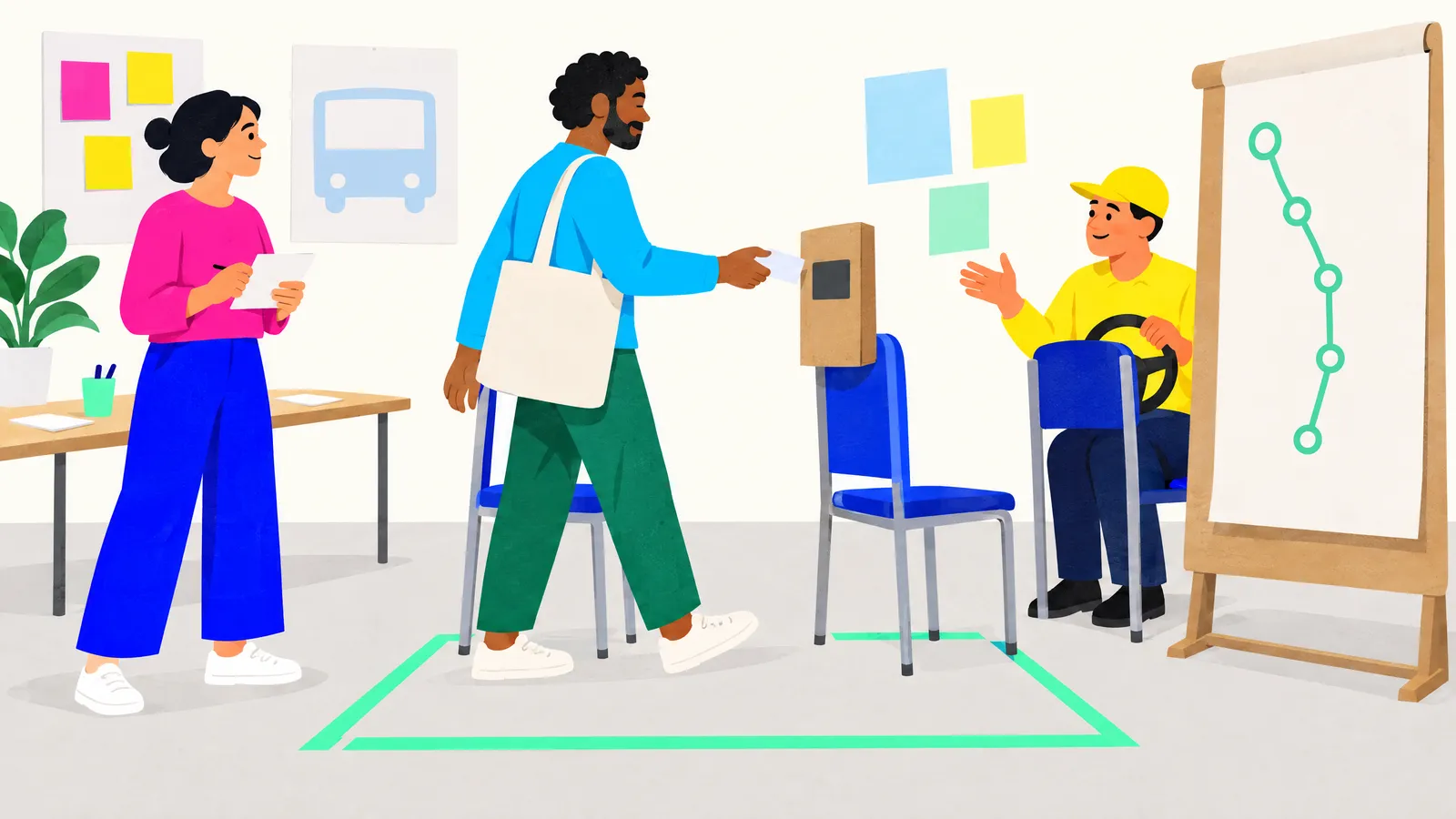
A low-fidelity boarding rehearsal makes the order of actions visible without building a working vehicle interface. Source: AI-generated editorial illustration for move lab.
Timing: four minutes define the scenario and roles, five arrange the props, and six run the first version. The group then has six minutes to change one element and repeat the affected interaction. Four minutes capture observations and limits.
The task describes a goal, not the intended steps. The Government Digital Service's moderated usability testing guidance (2017) says tasks should be “relevant and believable to participants” and shouldn't hint at the answer. For this rehearsal, “You want to board the bus that reaches your destination” leaves room for uncertainty. “Scan here, then follow the green arrow” removes it.
An observer records visible actions separately from interpretations. “Looked between the reader and the driver” is an observation. “Didn't trust the reader” needs a follow-up question. The second round changes one cue so you can discuss what difference it made.
This is a rehearsal, not a safety assessment. Colleagues know the concept and may unconsciously help it succeed. Passenger research is still needed, and an indoor mock-up can't establish whether a real boarding area is safe.
Nor does role-playing a disability reproduce someone's access needs. GOV.UK's guidance on research with disabled people advises accounting for individual needs and participants' own assistive technology. Actual participation provides evidence that a blindfold or borrowed wheelchair cannot.
A 90-minute session needs a decision, not more activities
A busy agenda can produce several outputs that don't connect. A journey map names one problem, sketches answer another, and the final presentation reports general enthusiasm. You've used the room well but haven't moved the work forward.
For a team that already knows the method, a suggested session combines five minutes to agree the question, 20 for journey reconstruction, 15 for silent sketches, 25 for role-play, 15 to review evidence and ten to assign follow-up work. The total is 90 minutes. It excludes recruitment and preparation; the phone exercise is an alternative introductory session, not another activity squeezed into this one.
Mixed disciplines help when each contribution addresses the same trip. A transport planner can question a physical constraint while a service designer checks a confusing handoff. The lab's Mobility Stations Workshop brought disciplines together around intersections of transport modes. Your shorter meeting needs a much narrower scope than that one-week workshop.
The final record can be brief: the observed problem, the proposed change, the evidence still missing and the person responsible for obtaining it. A test plan then names actual or likely users and what behaviour would support or challenge the idea. Colleague approval is feedback, not proof of passenger demand.
The best exercise leaves you with a testable next question
A team can leave a workshop pleased with its prototype and still be unable to say what it learned. That happens when completion becomes the goal. A full sheet or confident presentation is easier to recognise than a useful change of mind.
Your strongest design thinking exercises end with a specific uncertainty that someone can investigate. Say the boarding rehearsal suggests that confirmation arrives too late. The next question is whether passengers recognise it before moving away, not whether they like the proposed service.
The timer protects the meeting. The question protects the project. A short exercise earns its place when it changes what you'll examine next—and leaves you honest about what you still don't know.
Frequently asked questions
Can beginners complete a full design thinking cycle in an hour?
Yes, as a learning exercise with a narrow prompt and rough prototypes. The 60-minute phone format includes interviews, problem framing, ideas, building and testing. It doesn't provide enough evidence to approve a transport service or street change.
How many people should join a mobility design workshop?
For the formats here, 4–12 people is a useful working range, divided into pairs or small groups. The phone exercise also works with just two people. Larger workshops need more facilitation and separate space for each group.
Can these activities work remotely?
Phone interviews, journey mapping and silent sketches can work through calls and shared documents, with private screens kept off the call. Service role-play needs more adaptation because movement and physical cues matter. A remote rehearsal can test dialogue, but it won't reveal the same spatial problems.