A fictional taxi, a toy passenger or a bedtime story can expose assumptions that a polished mobility proposal leaves hidden. The useful outcome is a better question before you commit to a real service.
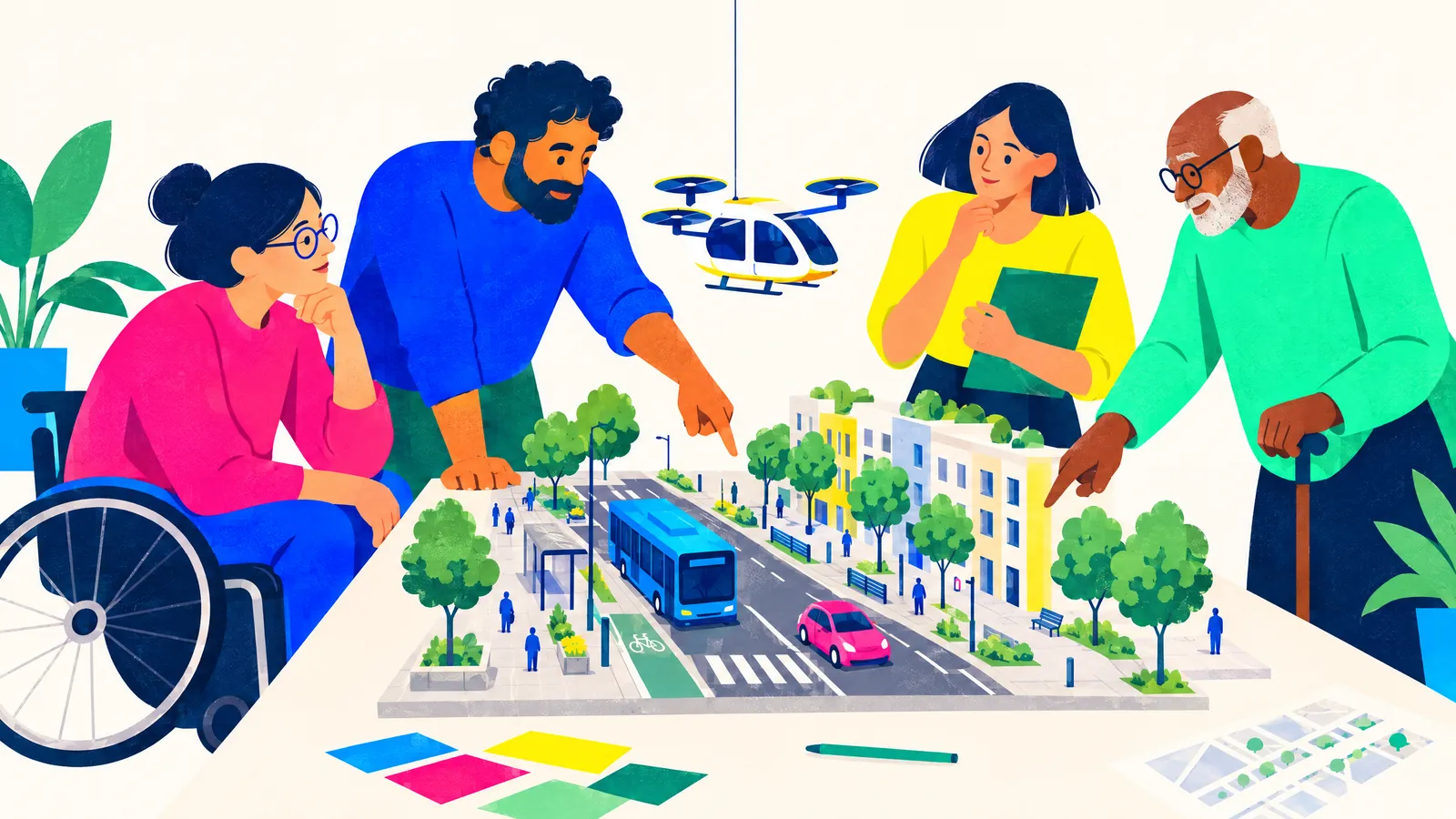
Say a Berlin neighbourhood is considering a pickup point for a future autonomous taxi service. The proposal shows a quiet vehicle beside an empty curb. At school collection time, that same curb holds a delivery van, a parent with a pushchair and someone who can't step across a puddle. Speculative design lets you debate that second scene before procurement begins. You can put an imagined service into everyday life, then ask what it demands from people who never chose to use it.
That question connects directly to move lab, a Berlin urban-mobility lab building prototypes, open-source tools and data visualisations. Our projects have used fictional transport services, student workshops and a children's book to make future mobility discussable. Those formats serve a practical purpose: they give people something specific to disagree about before a concept becomes a commitment.
What speculative design lets you test before a pilot
A mobility proposal often settles the technology before it settles the public question. A team asks how to book a flying taxi, for example, before asking who should tolerate its landing site. Once a polished interface exists, discussion can drift into improving the booking flow. The service's place in the city receives less attention.
Anthony Dunne and Fiona Raby's Speculative Everything: Design, Fiction, and Social Dreaming (2013) describes possible futures as tools for understanding the present and debating futures people want or reject. In the book's opening chapter, they ask:
“what does preferable mean, for whom, and who decides?”
That's the question a practical exercise should keep open. You might show a fictional boarding pass, a household's night-time travel diary or a notice announcing a new curb rule. Each object makes an assumption visible. A boarding pass can reveal that your service expects passengers to own a phone; a curb notice can reveal that residents bear costs without receiving benefits.
This work can happen before you build operational equipment. It still involves making things, but a prop carries an argument rather than a passenger. It won't establish demand, certify safety or prove a business case. Its value lies in finding questions that those later tests need to address.
The futures cone separates likelihood from preference
Teams can confuse a desirable outcome with an expected one. A shared autonomous fleet might sound attractive because it promises fewer parked cars. That doesn't establish whether the vehicles will arrive, whether people will share them or whether released parking space will become public space. Each step depends on different decisions.
The futures cone helps separate these judgements. Joseph Voros (2017), in his account of the cone's use and history, distinguishes probable futures based on current trends, plausible futures consistent with current understanding, and possible futures that may require knowledge we don't yet possess. Preferable futures concern what people think should happen. Preference can cross the other categories; it isn't a higher level of certainty.
Dunne and Raby adapted a cone diagram presented to them by futurist Stuart Candy. They didn't invent the whole framework. For your workshop, the useful part is the separation of questions, rather than treating any version as a universal classification system.
You can ask participants to explain why they place a scenario in a category. “This could happen” needs a chain of conditions. “I'd like this to happen” needs an account of whose interests it serves. Someone may want a service they consider unlikely, or expect one they strongly oppose.
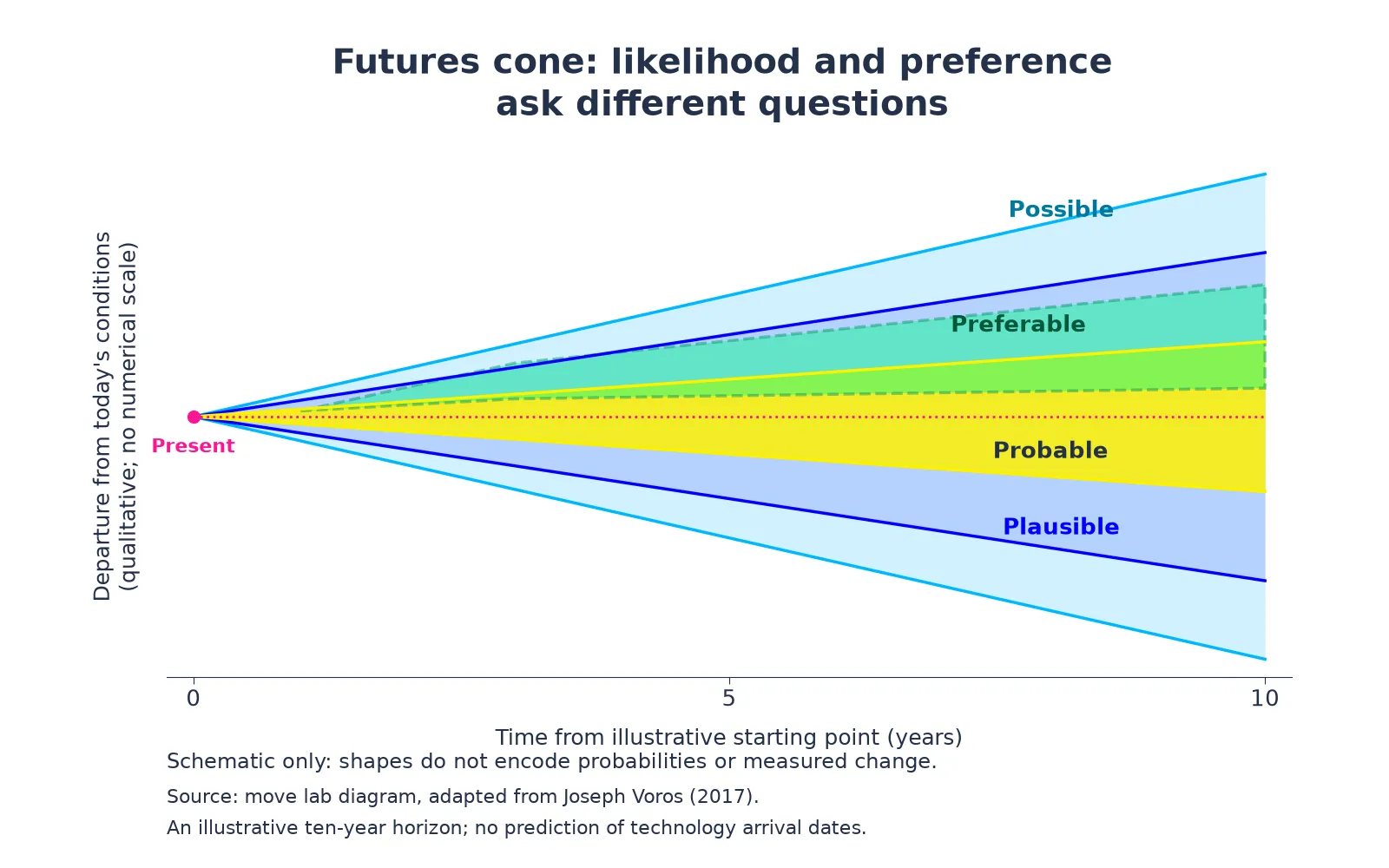
Likelihood and preference answer different questions. The widening shapes are conceptual, not measured probabilities; the ten-year horizon is illustrative. Source: move lab diagram, adapted from Voros (2017).
The diagram doesn't tell you the probability of a drone taxi arriving in a particular year. Nor does its centre describe an inevitable future. Categories depend on today's knowledge and can change. Recording the assumptions beside each scenario is more useful than arguing over a dot's exact position.
A drone taxi exposes the questions a render hides
A picture of an aircraft above a city says little about using it. Where does your suitcase go? Who gets access? What happens to people beneath the route? Spectacle can crowd out ordinary service questions, even when those questions decide whether a concept belongs in daily life.
The Autonomous Human Drone Taxi experiment used a fictional video report to provoke discussion. We didn't lift reporter David Leonard with a drone. The project was a deliberately playful hoax, built to get people thinking about autonomous drone taxis rather than demonstrate a working passenger aircraft.
Our making-of account of the drone taxi video records questions about safety, energy consumption, service access and carry-on luggage. These aren't evidence that the imagined service would succeed. They're examples of how a tangible fiction can move a conversation beyond whether the technology looks exciting.
For a contemporary public exercise, I would label the fiction clearly. The original hoax format drew attention, but ambiguity can be costly when you're discussing public spending or safety. A scenario label allows participants to challenge the proposition without first having to establish whether an announcement is real.
A useful follow-up separates questions by what would answer them. Engineering analysis addresses energy requirements. An accessible boarding mock-up explores physical access. Public deliberation addresses acceptable noise or the use of shared space. You don't need a flight-ready vehicle to identify those tasks, and a persuasive film can't substitute for them.
A workshop needs an open brief and a bounded question
“The future of mobility” is so broad that a workshop can end with unrelated inventions. The opposite problem is a brief that quietly predetermines the answer: “Make people trust our autonomous shuttle.” Participants can decorate a decision without being allowed to question it.
Our future-mobility workshop at HfG Schwäbisch Gmünd offers a different starting point. Twelve Communication Planning and Design master's students worked for one week in April during the 2015 summer term. The lab developed the workshop with Prof. Marc Guntow and Vera Angstenberger, with J. Paul Neeley as its external host.
The brief opened discussion about the social, cultural and ethical implications of future mobility technologies. Starter questions helped students begin; research and feedback helped them develop concepts. Outcomes could use different media, including mock-ups, simulations and video. The aim included debate about positive and negative human consequences.
You can preserve that openness while giving your own session a clear boundary. Say your question is: “How might night-time shared mobility change life on a residential street by 2036?” The time and setting make the exercise manageable. Participants can still question the service, its ownership and whether travel needs could be met another way.
The UK Government Office for Science's Futures Toolkit (2024) makes this distinction explicit: scoping the future of the car can miss changes in transport or mobility more broadly. A good boundary defines the problem without selecting the vehicle. Otherwise, you may spend the whole session improving a solution to the wrong question.
Tiny props can challenge a full-size mobility assumption
Professional diagrams can make familiar transport arrangements look inevitable. Change the scale and the arrangement becomes easier to question. A toy passenger stranded beside a toy vehicle can expose a boarding problem faster than a discussion about the abstract “user journey”.
In Wrkshp: Mobility Insights for Barbie, we sponsored a workshop at the University of the Arts Bremen, led by artist and tinkerer Niklas Roy. Nine students developed prototypes over six days in early May. The fictional brief gave Barbie difficulty walking long distances and asked for new ways to move her and Ken. The outcomes included a “Connected Cloud” transport concept.
This workshop widened the scope into visionary art. Some ideas crossed into fantasy, beyond the scientifically grounded scenarios Dunne and Raby describe. That difference matters: an absurd object can challenge an assumption without providing a credible account of future technology.
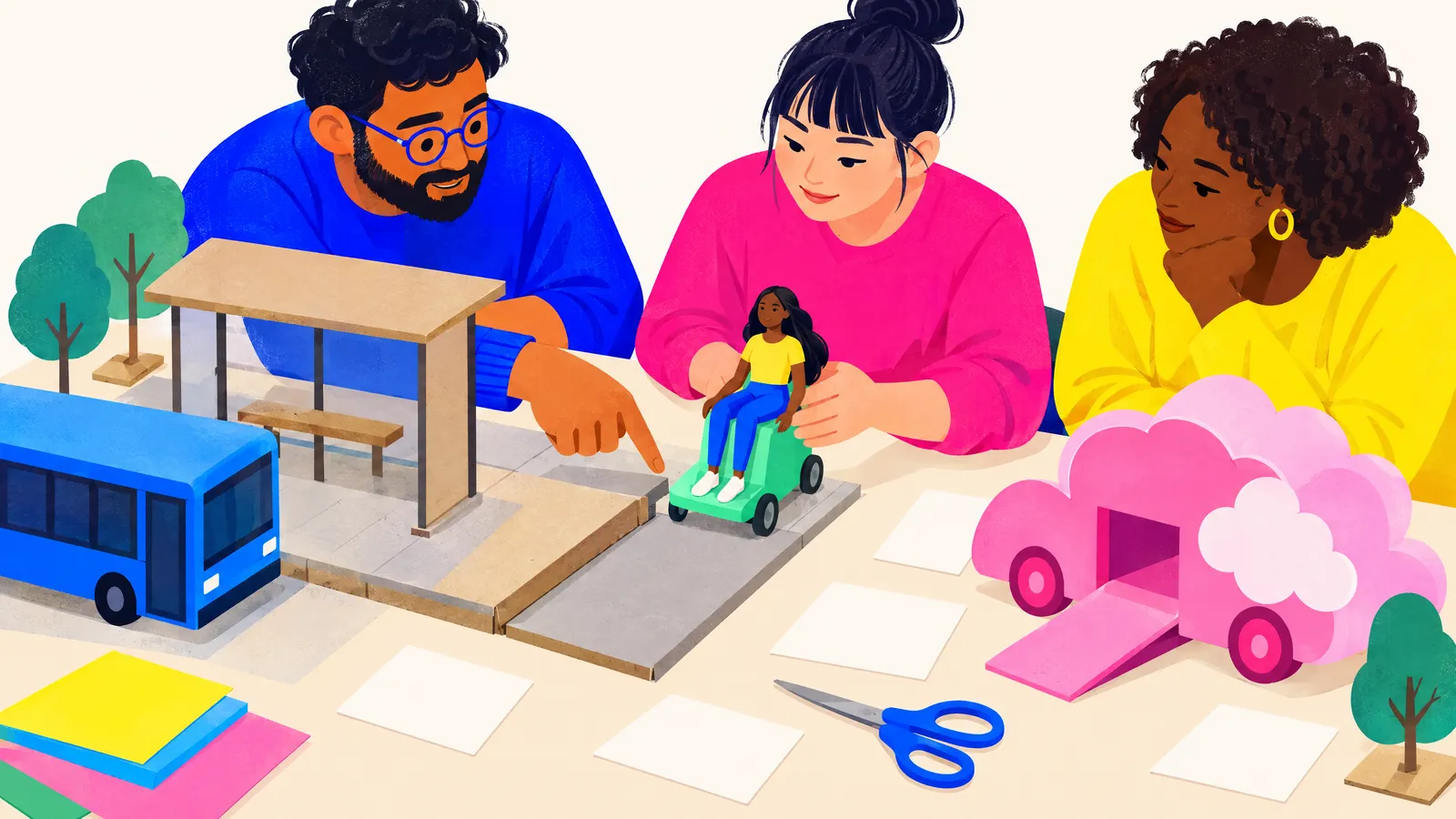
A small prop can make a boarding assumption visible before a full-size vehicle exists. This is an illustrative scene, not documentation of the Barbie workshop. Source: AI-generated editorial illustration for move lab.
For your session, a doll and cardboard curb could help discuss who must adapt: the passenger, the vehicle or the street. But a doll can't represent disabled people's lived experience. The prop gives a discussion a physical reference; people with relevant experience need to shape the question and interpret what the exercise misses.
A bedtime story brings the night shift into view
A service diagram usually stops when the passenger leaves. The vehicle keeps going. Cleaning, charging and other tasks happen somewhere, potentially beside people trying to sleep. A daytime-only story leaves those consequences outside the frame.
Where Do Cars Go at Night? follows CARLA-15, a fictional self-driving car in a shared fleet. She transports people during the day and helps with tasks while people sleep. We discussed the book with children in Erkrath and Stuttgart, as well as autonomous-mobility expert Sven Beiker.
The useful move is the change of audience and clock. A children's story brings a technical subject into a recognisable routine: bedtime. It creates room to ask what a vehicle does when the person who booked it isn't watching.
The book describes an imagined future. Its expectations about autonomy shouldn't be read as established findings about safer streets or deployment dates. That caution leaves the story's discussion value intact.
You could use the same format to write a fictional building resident's night. Say a shared car waits outside at 02:00, then leaves to charge. Who hears it? Who cleans it? What if its next passenger needs assistance? A second version could give the vehicle a depot away from homes. Comparing the stories reveals decisions hidden inside the phrase “the fleet operates overnight”.
What would a useful session look like?
An engaging workshop can still produce little that a planning team can use. People debate a film, vote for a favourite concept and leave. The team remembers enthusiasm but can't explain which assumption changed. The format needs to connect the imagined scene to an open decision.
Say you're reviewing that hypothetical Berlin night-time pickup point. Four elements would give the exercise a workable structure:
- A decision statement: whether a residential pickup location should proceed to further assessment, with its location and operating rules still open.
- Contrasting scenes: the same street with a nearby pickup, a more distant shared stop, and a service model that meets some needs without extra vehicle trips.
- Objects people can interrogate: a fictional resident notice, a boarding model and a night-time service diary, all marked as scenarios.
- A question record: what participants challenged, what evidence could resolve it, and who will take that question forward.
The alternatives shouldn't be an attractive future beside deliberately poor ones. Each needs an honest benefit and a consequence that someone might resist. Your distant stop may reduce disturbance near homes while increasing the effort of reaching a vehicle. That conflict deserves discussion rather than a visual trick that makes one option win.
Participants can examine each scene from their own position before hearing the team's explanation. This reduces the chance that your rationale becomes the only accepted reading. You can then ask, “What would have to be true for this to work for you?” It's a better question than “Do you like it?” because the answer can identify a condition: assistance at boarding, a reliable fallback or a limit on operating hours.
A useful record distinguishes a disputed value from missing evidence. Disagreement over who gets priority at a curb may require a public decision. Uncertainty about boarding clearance calls for a physical test. You can't settle the first with a measurement or the second with a popularity vote.
Debate has to reach people outside the design room
A design team can mistake its own fluency for public understanding. Participants who enjoy future-tech stories may dominate, while someone concerned about losing a familiar bus stop says little. A workshop's invitation list can shape the apparent result before the first prop appears.
The OECD's Guidelines for Citizen Participation Processes (2022) calls for clear objectives and an explanation of how public contributions will affect decisions. It also describes closing the feedback loop: telling participants what happened to their inputs, including why proposals weren't taken forward.
For your mobility exercise, that means explaining which decisions remain open before asking people to contribute. An exploratory session doesn't carry the authority of a representative public process. Its reactions shouldn't become percentages in a demand forecast.
The invitation needs to include people affected by the imagined operation, even if they aren't potential customers. Materials also need to work without specialist vocabulary or a smartphone. Where children participate, the story should leave room for disagreement; adults shouldn't treat an entertaining response as approval of a transport policy.
And participants deserve an account of what changed. If their concerns lead to a different location study, that is worth reporting. If nothing can change, the team needs to explain that limit rather than promise influence it can't provide.
A changed decision is the output that matters
A memorable prop can survive long after its question disappears. The drone model becomes a presentation image; the workshop becomes a list of imaginative concepts. Neither tells a planner what to do differently.
The stronger output is a decision record. It names an assumption that survived challenge, an issue that remains contested and the next piece of evidence needed. For the hypothetical pickup point, that might mean assessing a different location, testing assisted boarding or deciding against further development. Those are possible outcomes, not reported lab results.
The lab's video, workshops and book show different ways to make future mobility available for discussion. Their practical lesson is that you don't have to wait for operational hardware to examine human consequences. You do need to keep fiction distinct from evidence and give disagreement a route into the next decision. A useful imagined future leaves your team less certain about its assumptions and more precise about what it needs to learn.
Frequently asked questions
How is a future scenario different from a prototype test?
A future scenario lets people debate the assumptions and consequences of an imagined service. A functional prototype test examines what a particular implementation does. You can use both, but reactions to fiction cannot establish technical safety or likely demand.
Do mobility scenarios need to be technically feasible?
That depends on the question. A plausible scenario needs a defensible explanation of how its conditions could arise; an absurd prop can help challenge an assumption without claiming to work at full scale. The audience should know which kind of exercise they are seeing.
What should a mobility-futures workshop produce?
Useful outputs include contested assumptions, conditions for acceptance and research questions with named owners. A scenario or prop gives participants something concrete to discuss. The team should also explain which decisions remain open and report what happened to participants' contributions.