Temporary street changes can answer expensive planning questions. A useful pilot pairs removable materials with comparable counts, access checks and a decision agreed in advance.

A painted corner can look successful while making a delivery driver's morning worse. A temporary cycle lane can attract riders because the sun finally came out. Tactical urbanism gives you a way to test street changes with low-cost, removable materials, but the materials don't make the test credible. Comparable observations do. The useful question is narrower than “Did people like it?” You need to know what changed, for whom, and whether the change justifies the next investment.
That question connects two kinds of measurement at move lab, a Berlin urban-mobility lab building prototypes, open-source tools and data visualisations. Our What the Street!? mobility-space report compares the space allocated to mobility by packing parking shapes and rolling streets and tracks into bins. Our OpenDataCam object-counting project uses computer vision to count traffic participants locally. Space allocation helps you frame the problem; movement counts help you test a response. Neither supplies the verdict by itself.
What makes tactical urbanism an experiment?
A row of planters outside a bakery might be a celebration, a traffic intervention or an informal extension of the shop. Without a stated question, those purposes get mixed together. You won't know whether to judge the installation by visitors, crossing behaviour or the number of croissants sold.
For this guide, the approach means a temporary, low-cost change to street use that helps inform a longer-term decision. A painted curb extension, removable seating or a short protected cycle-lane segment can test different questions. The experiment begins when you specify the behaviour you expect to change and what evidence would challenge that expectation.
NACTO's Urban Street Design Guide (2013), in From Pilot to Permanent, describes Willoughby Plaza's temporary closure in 2006 and permanent opening in 2013. It also states:
“The level of permanence depends on the individual project, but should always be communicated at the outset.”
Your pilot therefore needs a public end date and an honest account of what remains undecided. Temporary materials don't promise temporary political consequences. Residents who've changed their routines deserve to know how you'll decide what happens next.
One corner needs one primary question
Say you're working on a Berlin neighbourhood corner where parents wait beside parked vehicles before crossing. One proposal combines seating, planting, a wider waiting area and a weekend street closure. If behaviour changes, you can't tell which element helped. That's an expensive ambiguity, even with cheap equipment.
A more useful first test changes the waiting-area geometry while leaving the rest of the street operation unchanged. Your hypothesis might be: “A temporary curb extension will increase use of this crossing without creating access or loading problems.” The proposed mechanism matters: the layout changes where people wait and how they approach the crossing.
Your primary metric could be pedestrian passages through a fixed crossing boundary per observation period. That measures use, not unique visitors or safety. Someone who crosses twice contributes twice. If your actual goal is shorter waits, waiting time belongs in the primary metric instead; pedestrian volume can't answer that question.
The measurement brief can fit on one page:
- The question identifies a behaviour, location and intended user benefit.
- The primary metric has a counting boundary, unit and observation schedule.
- Guardrails specify outcomes that cannot be traded away, such as accessible passage and emergency access.
- The decision rule explains when the team will retain, revise or remove the installation.
You might propose a 20% increase in crossing use as a practical signal for further investigation. That's an illustrative threshold, not a research standard. It needs agreement before installation, alongside checks that any increase exceeds ordinary local variation. Changing the target after seeing the result makes the evaluation less persuasive.
Cheap materials still need an operating plan
A planter can solve one problem and cause another. It might block a driver's view of a child, narrow a wheelchair route or force a courier to stop in the cycle lane. A cheap object becomes costly when nobody owns its daily inspection.
For a permitted street trial, your road authority and a qualified designer need to review the layout against applicable local requirements. The review covers visibility, accessible routes, turning movements and the approved traffic-management arrangement. Paint alone shouldn't be treated as protection from vehicles. Materials need to suit the actual exposure and operating conditions.
Before installation, discussion with nearby users can reveal details a plan misses. A bakery may receive flour before the observation team arrives. Someone using a mobility aid may take a different route from the one you expected. These conversations help you define the test; they aren't a substitute for an approved design.
Say you allocate €3,000 to a small pilot: €900 for removable materials, €800 for installation and removal, €600 for observation, €400 for maintenance and €300 for contingency. The allocation totals €3,000. It's a hypothetical budget, not a supplier quote, and assumes permissions and design work are funded separately. Keeping observation and removal visible prevents the installation from consuming the whole budget.
A named person needs authority to pause the trial if barriers move, access fails or a dangerous manoeuvre appears. There's no reason to wait for the scheduled review when a safety problem needs attention. The log records each adjustment, because a changed layout is a changed experiment.
A sunny after-count needs a comparable before-count
One wet Tuesday before installation and one sunny Saturday afterward can manufacture an apparent success. So can the school holidays. Your baseline needs enough coverage to reveal the street's usual variation, rather than one convenient photograph of it.
The Federal Highway Administration's Traffic Monitoring Guide, Chapter 4 (2013) warns that very short pedestrian and bicycle counts can produce large errors. It suggests at least 4–6 hours for manual counts and at least 7 days for automatic short-duration counts in typical weather. Those recommendations concern traffic monitoring; they don't guarantee that a pilot evaluation can establish cause and effect.
For your test, observation windows should match by weekday, clock time and relevant conditions before and after installation. Weather, school schedules, roadworks and events belong in the record. Four-hour sessions can answer a question about those hours; they aren't a basis for claiming annual footfall without further evidence.
A nearby comparison site helps you see changes unrelated to your installation. It needs similar activity patterns and shouldn't receive traffic displaced by the trial. Counts at both sites happen during the same windows. If the comparison street changes too, your pilot may be operating within a wider trend.
A workable schedule reserves baseline observations before any materials arrive, separates opening-day curiosity from ordinary use, and repeats observations after the layout has settled. Automated coverage across weekdays and weekends is useful where resources allow. Otherwise, a narrower claim supported by repeated manual sessions is better than a citywide claim supported by an afternoon.
A camera count needs a human check
A camera might miss people behind a van or confuse a moving bicycle with another object. The errors can change after installation if a planter blocks the view. You don't want your “improvement” to come from moving the camera.
OpenDataCam V2's camera and local-computer setup counts and tracks moving objects. Its interface lets you specify counting areas, and you can export tallies and traces. These features support repeatable movement observations, provided your installation, settings and counting definitions remain comparable.
A useful field method checks automated counts against simultaneous manual observations in representative conditions. The check includes busy periods and likely obstructions. Results need to be recorded separately for each mode: a good vehicle count doesn't establish a good pedestrian count. If discrepancies are large or change between phases, the result needs qualification or recollection.
Manual notes answer questions the tally can't. They can record someone waiting for a blocked loading space to clear, a wheelchair user unable to pass, or people stepping around a barrier. For a seating pilot, repeated occupancy snapshots answer a different question from counting people who walk past. The methods should follow the question, rather than the equipment you happen to own.
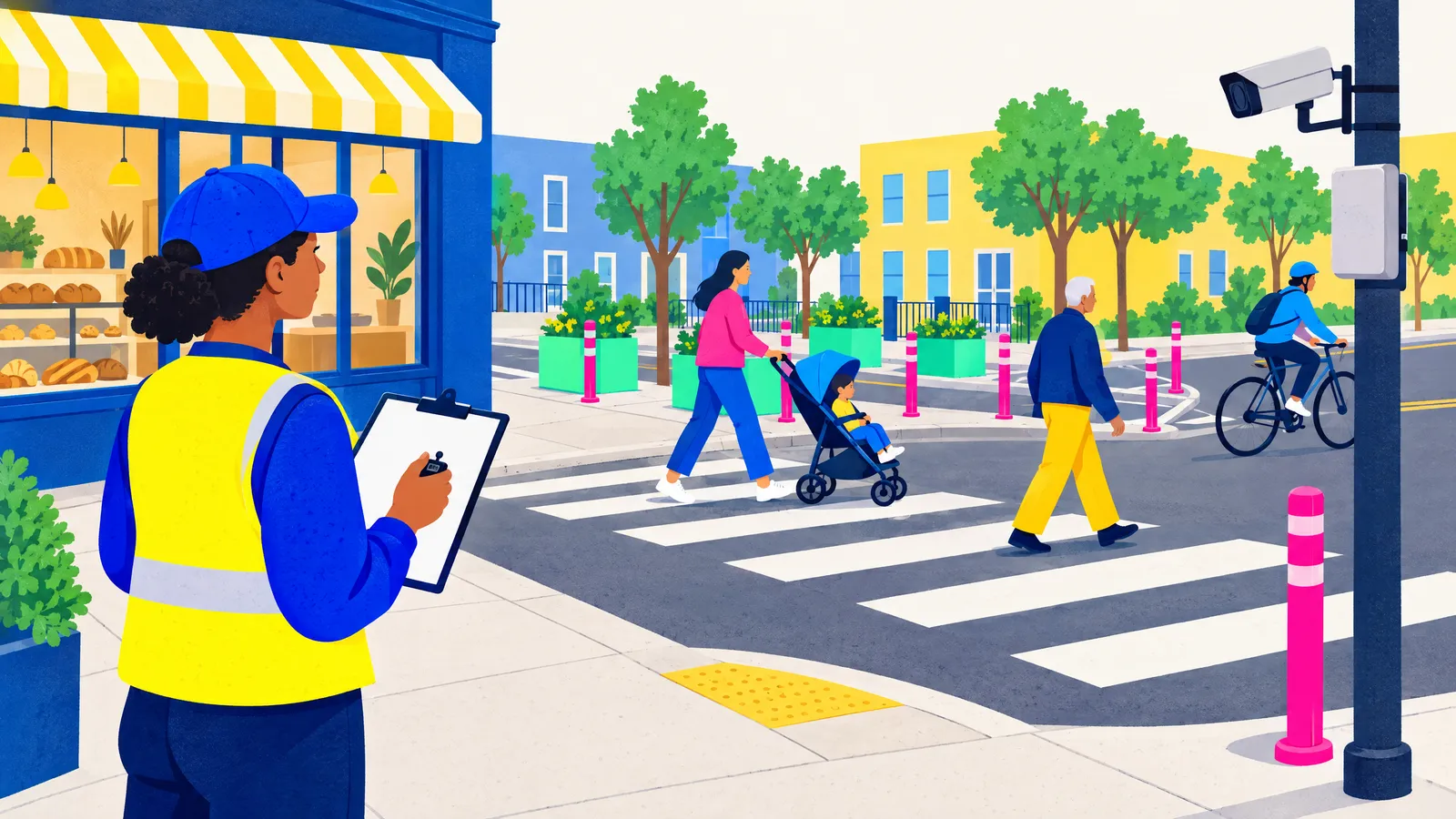
Manual observations can explain access problems and check automated crossing counts. Source: AI-generated editorial illustration for this article; fictional scene.
Privacy also needs a decision before the camera goes up. The European Data Protection Board's video-device guidelines, version 2.0 (2020) explain data minimisation and transparency duties. Local processing doesn't automatically remove legal obligations. Your responsible authority needs to assess the lawful basis, necessity and notice requirements for the actual setup. A counting task rarely needs identifiable footage in a public report; aggregate counts, restricted access and a defined deletion schedule reduce unnecessary exposure.
What do the before-and-after numbers actually say?
An increase of 36 pedestrian passages sounds convincing until the nearby corner increases too. Percentage changes can also exaggerate small baselines. Your report needs absolute counts and enough context to distinguish a promising signal from a firm conclusion.
Consider a clearly hypothetical example. You observe four matched four-hour sessions in each phase at both sites. Mean crossing counts rise from 120 to 156 passages per session at the trial corner. At the comparison corner, they rise from 120 to 132. These are invented teaching figures, not results from move lab or a city project.
Here is the arithmetic:
Trial change: (156 − 120) ÷ 120 × 100 = 30%.
Comparison change: (132 − 120) ÷ 120 × 100 = 10%.
Difference in changes: (156 − 120) − (132 − 120) = 24 extra passages per four-hour session.
That last calculation is an additive difference-in-differences: the trial's change minus the comparison site's change. It adjusts for a shared background change if the comparison site's trend is a reasonable stand-in for what would have happened without the trial. Similar starting counts don't establish that assumption; earlier trends and local conditions need examination.
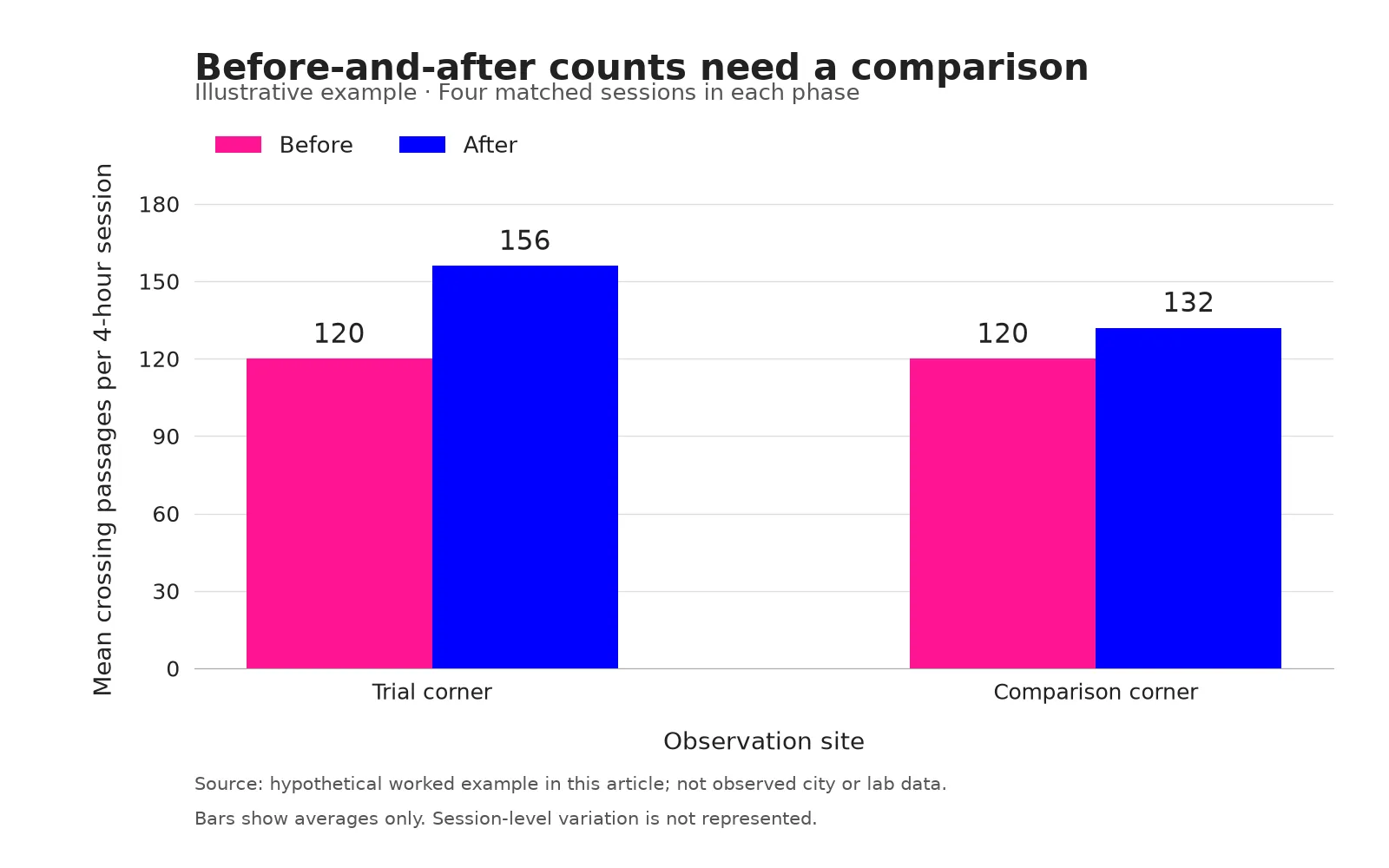
The trial gains 36 passages per session; the comparison gains 12. Their difference is 24, subject to the comparison assumptions. Source: hypothetical worked example in this article; not observed city or lab data.
Those averages don't show uncertainty. Your public report should also show individual sessions, observation hours, missing periods and any counting errors. Four sessions per phase don't automatically establish a dependable effect. A result driven by one unusually busy day deserves more observation.
Nor does more crossing use establish safer crossing. A short pilot usually can't support a crash-reduction claim. Behavioural observations can identify concerns and inform design revisions, but they don't turn a week without incidents into proof of safety.
A popular opening doesn't settle who benefits
Opening-day visitors may enjoy the new seating while regular bus users face delays. A shopkeeper may report enthusiasm while an older resident quietly stops taking that route. Headline footfall can hide those losses.
NYC DOT's Measuring the Street (2012) reported a 77% increase in seated pedestrians at Pearl Street in Manhattan. The report also evaluates street projects through measures including traffic performance, user satisfaction and economic activity. The useful lesson is the range of outcomes, not an expectation that your installation will reproduce that figure.
Your evaluation needs some observations beyond the primary count. For the hypothetical corner, that might mean loading obstruction minutes and repeated access checks. Short interviews can ask what changed in a person's actual trip. A satisfaction percentage based on self-selected comments shouldn't be presented as representative neighbourhood opinion.
The making-of explanation for What the Street!? offers another useful lens: mobility-space comparisons need a consistent area scale. Your own trial record can distinguish space newly available to people from space still occupied by equipment. A planter takes space too. A colourful installation that leaves little usable room can perform badly despite an attractive photograph.
The next investment needs a recorded decision
A pilot can drift into permanence because removal feels awkward. It can also disappear after one complaint despite useful results. Both outcomes waste the chance to learn from the temporary change.
The strongest contribution of tactical urbanism is a better decision about the next commitment of street space and money. Your closing review compares the agreed hypothesis with the counts, then examines the guardrails and unresolved questions. Promising use with a loading conflict supports revision. Repeated access failures support stopping the trial, even if overall footfall rises.
The public record can be short: the tested layout, observation schedule, results, limitations and the decision owner. It needs to state the next action and review date. If a permanent design proceeds, its materials and operation may differ from the pilot; those differences need their own assessment. The experiment earns its cost when someone can explain what the temporary street taught them—and what it couldn't answer.
Frequently asked questions
How much should a temporary street pilot cost?
There isn't a universal price: permits, traffic management and staff time can cost more than the removable materials. A useful budget separates installation, observation, maintenance and removal, with funding reserved for each. The €3,000 allocation in this article is a hypothetical planning example, not a market estimate.
Can manual counts replace a street-counting camera?
Yes, if your question and observation hours fit the staff time available. Manual observers can record access problems that an object counter won't explain. Cameras can extend coverage, but their counts still need checks against human observations.
Does a before-and-after increase prove a pilot worked?
No: weather, events or a change in nearby routes can also increase counts. Matched observation periods and a nearby comparison site make the result easier to interpret, but they don't remove every alternative explanation. A permanent decision also needs evidence about access, safety and maintenance.